
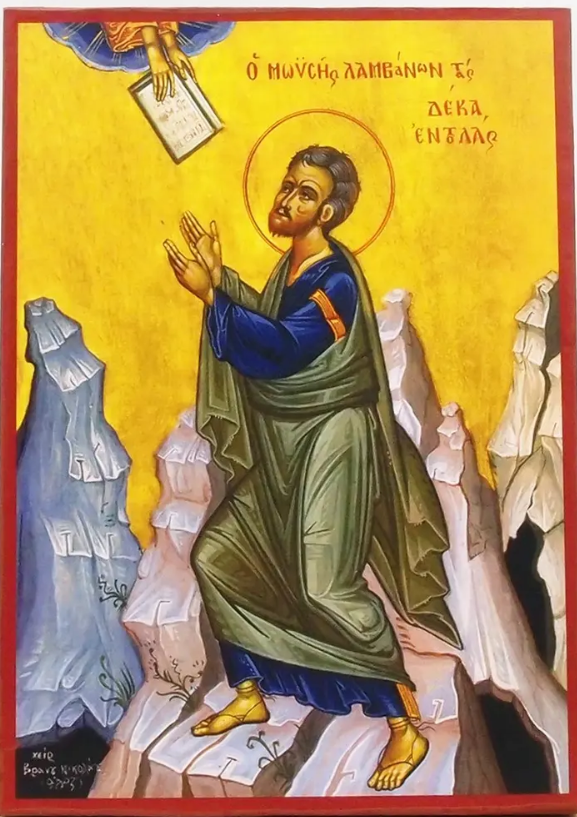
Ever since I can remember, I have known that lying is wrong. From the gentle words of my mother to the stern looks from my father, I learned that not telling the truth, lying, was not right. I also knew from Church that it made God angry as well, as lying was against one of the big rules, the Ten Commandments. The ninth commandment[1] (Exodus 10:16) given by God to His people states, “Thou shalt not bear false witness.” While this law seemed simple to understand as a child, like many things in life, I later understood that those six words were not so simple to interpret. There are grey areas.
Mother Maria Skobstova[2] is a 20th-century saint of the Orthodox Church who is remembered for being part of the French Resistance in World War II and murdered at the hands of the Nazi regime. She was sent to the gas chamber at Ravensbrück concentration camp one day before Pascha in 1935. In a book of her essential writings, Jim Forest, in his introduction, relates a very telling and human story from Mother Maria about how precarious life was for those who lived through the horrors of the twentieth century, especially World War II and the Holocaust. Soon after Paris fell to Nazi Germany’s rule in 1940, Jews, among others, had to register with the authorities. Some brave Christians secretly began to help those subjected to Nazi persecution.
“Jews began to knock on the door of rue de Laurmel asking Father Dimitri (Klepinin)[3] if he would issue baptismal certificates to them. The answer was always yes. The names of those “baptized” were also duly recorded in his parish register in case there was any cross-checking by the police or Gestapo, as indeed did happen. Father Dimitri was convinced that in such a situation Christ would do the same.”[4]
The riveting true story about Father Dimitri falsifying baptismal records in order to save Jews, touched me deeply and brought up several thoughts. One is that the lying was committed by a priest. The second is that a nun approved of the actions of Father Dimitri, as is evident from Mother Maria’s own writings. A third is the nature of the lie, concerning a mystery of the Church, holy baptism, and one can assume listing the chrismation as well, as is the custom of the Orthodox Church to celebrate the two sacraments together. Also, that the lie was not only in issuing a false certificate, but also in recording the lie in the parish metrical books[5]. It moved me that Father was convinced he was doing what Christ would have done. And finally, that even knowing about this lie, the Orthodox Church canonized Father Dimitri.
The actions of Father Dimitri are frequently debated by Christians. Is it ever alright to lie and under what circumstances? Today, we would call this situational ethics, which unfortunately has such a negative connotation. It refers to a decision based on a specific context rather than on a universal rule. More grey than black and white.
Today, rarely are many of us put into life-and-death situations and have to lie. However, LGBTQ Orthodox and even our allies are often put into similar situations, where we choose, or more likely have to, lie frequently to protect ourselves. How many LGBTQ Orthodox are afraid to come out to their parish priest, worried that they might be barred from receiving Holy Communion? Two personal stories bring this to mind: once being asked if my wife was also a Ukrainian Orthodox Christian. Not feeling safe answering the truth, fearful that I might lose my teaching job, instead of answering that my husband is Greek Orthodox, I simply said no and changed the subject. Or an even more personal example of never telling my father I was gay because I was afraid, I would lose his love.
If Christ is truth and the truth will set us free (John 8:31-32), we should not be afraid to tell the truth, knowing that Christ would approve. I wish for a world, a Church that would fully understand that we are all created in God’s image. Until then, I hope and realize that at times I might have to lie. May God forgive!
[1] https://www.goarch.org/-/the-ten-commandments
[2] https://en.wikipedia.org/wiki/Maria_Skobtsova
[3] More about Saint Dimitri can be found here. https://www.centenaire-archeveche.org/en/pere-dimitri-klepinine
[4] Mother Maria Skobtsova. Essential Writings. Orbis Books, 2003. Page 32
[5] This is the term for the record books of a parish church, where baptisms, marriages and deaths are usually recorded.
I’ve reached a couple conclusions in my pretty long life. One is that we are ALL created in the image of God, the Infinite, Unknowable, Ever Merciful. And a Church that is less loving, less merciful, less understanding than God either doesn’t know Him, or doesn’t reflect Him. The Church is just a vehicle…….